Anecdotes and other stories

Some nice anecdotes
Knegtel was the first garage company that allowed cars to participate in the carnival parade in Tilburg and was very successful with that.
~~~~~~
In periods of introduction of new models, many cars were traded in. These cars were being prepared for sale, but until then they were parked at rented locations. Veemarktstraat, Gasthuisring and Beka grounds were used for this, much to great annoyance of Grandpa Knegtel. First the maximum was 50 pieces trade-in, later 100 and then he stopped counting.
~~~~~~
De Heuvel garage also had social activities, especially by Knegtel children. Tim/Bob's Scalextric racetrack was sometimes used by mechanics during lunchtime, while the table tennis table in the cafeteria was used by club DUBONNET (Dorus+friends) on Saturday evenings.
~~~~~~
There was a go-kart club that raced one evening every week, with Chris Fransen, Eddie Koolen and later also Dirk.
~~~~~~
Later, during the period of Knegtel Heuvel Parking, the former administration was set up for a children's nursery run by Carine.
~~~~~~
Building maintenance was carried out by the in-house carpentry and painting department. Kees van Dijk (carpenter), Jo Donia and Jos Schuurkens (painters) could also regularly be found in the houses of Jan and Fons.
~~~~~~
The car shows at Knegtel were always decorated with something special. Sometimes with an oldtimer or a rally or racing model, even living flamingos were used on the Spoorlaan. Unfortunately the flamingos saw the opportunity to get out of their residence in the evening and a phone call came that the birds were walking between the cars.
~~~~~~
The hobby evening was a great success and every Thursday evening until 10 p.m. employees (and Knegtels!) were given the opportunity to tinker with the car. It often got later and when this happened the hobbyists turned off the lights on the side of the Spoorlaan so that passers-by/clickers (!) saw nothing unusual.
~~~~~~
The pneumatic post was first introduced on the Ringbaan, with the necessary initial problems. Soon the post was also used for other things such as sending a dead mouse to the ladies of the administration. The Spoorlaan had a large semi-open tube for parts, so that Johnny Marijnissen (truck department) was also sent when he had a big mouth again.
~~~~~~
Toon Vekemans, employee from the very beginning at the payroll administration (Heuvel) has long worn his dustcoat with sleeve pieces to prevent wear. He handed out the pay packets weekly, later every 14 days.
~~~~~~
The administration knew accountants with a nickname. Ad van de Gevel (Ringbaan) was called “kuntje”; Paul Weijters (Heuvel) was called Paula; also “the lick” for his zeal to get it right for management.
~~~~~~
Every mechanic had his own toolbox. Special tools were issued by Jo Benzing (de Ringbaan) against presentation of a coin with the number of the relevant mechanic. However, tools regularly disappeared, which often led to quarrels between the mechanics.
~~~~~~
Knegtel's children regularly did holiday work at the company; this started with fl. 0.25 per hour for sorting (by numbering) petrol receipts. Later also help at the pump. Station attendants included Jan Gallé, Theo van Kuijk, Harry van Gorp.
~~~~~~
Cars also had to be lubricated (nipples) and had its oil changed in the beginning. Frans Olieslagers (Heuvel) and Jan Akkermans (de Ringbaan) did this at their own pace. Frans Olieslagers always with a cleaning cloth under his shoe; cleanliness in the foreground!
~~~~~~
The most famous tire man was Jozef van Esch, who always started in the morning by turning the tires in stock. The quality was such that tires at that time sag from the rack in which they were kept.
~~~~~~
New cars on the Spoorlaan were first parked along the track behind the garage, until it was noticed that the paint was speckled. It turned out that hot brake particles from the trains fell on the cars that burned in the paint.
~~~~~~
Many payments were made in cash, sometimes with more than fl. 100,000 in cash. Jan Schults then went to deposit at the bank with his bicycle. This money was then put in a supermarket bag, least conspicuously, under the bungee cord. Always went well….
~~~~~~
Theo Robben (Ringbaan reception) was the first gay person to come out. Hilarity at the time when booklets were removed from his desk drawer.
~~~~~~
Timo Brabers and sometimes also Bert Kuipers ( 24/7 service technician) had a problem coming to the office on Mondays sober. The joke was that you shouldn't get too close to them; you got drunk.
~~~~~~
Supporting the company's growth necessitated the recruitment of a business economist. Fred Erich helped with matters such as insurance, planning, strategy and budgets. Geert(?) Kuipers was later recruited for the step towards automation. He was not very popular because of his drive to change, which resulted in him being judged by the staff as "expensive, not good". This as a counterpoint to the advertising slogan of De Kuijper Vieux, “good, not expensive”.
~~~~~~
Some mechanics had higher aspirations after an apprenticeship. Wil van Rijn rose to become an importer of Ebro trucks, together with the owners of the Scania dealership. Henk Broerse, Frans van Riel and Jo Gerritsen started a shop in car parts/accessories in Tilburg (Autorama). Berry van Gansewinkel became a maintenance technician for the police and later a motorcycle cop.
~~~~~~
After some break-ins on the Spoorlaan ("where is the shit?") due to the crime along the track, Jan Schults, who lived in the upstairs apartment, got a large mean Bouvier from the Pessers family, Riel.
Thanks to Jan Schults, among others, for his many memories.
"The amiable rip-off"
.jpg)
The automobile company Knegtel and Wagemakers was founded by Theo Knegtel in 1913. Theo Knegtel had been nicknamed "The amiable rip-off". He became the first Ford dealer in the South of the Netherlands in 1921 and already sold T-Fords in 1919. His very first customer was Eduard van Spaendonck, who bought a Panhard-Levassor. The agreement for the sale was that Theo would be a driver if Eduard had to be 10 km outside Tilburg. The underlying reason was that many tires were punctured, which Theo then had to change. Until their deaths, Eduard and his wife were given a barrel of motor oil at Christmas.
NV Julienne

The fact that Theo saw entrepreneurial opportunities in everything is apparent from the fact that he founded “NV Juliënne” in the second half of 1918. Because of the First World War, food was scarce everywhere. NV Juliënne wanted to dry potatoes in Brabant so that the potatoes would have a longer shelf life and could be exported. However, when things finally got off the ground, the armistice was agreed and the First World War ended. This immediately put an end to NV Juliënne.

Injustice

Dishonesty was not to be trifled with at Theo Knegtel. Warehouse manager Kruisselbergen confessed to embezzling money and was forced to transfer his house and its contents to Theo. The building opposite De Ringbaan at Ringbaan Oost 315 was then occupied by Piet van Bladel on the 1st floor and Jan Akkermans on the ground floor.
Give a little, take a little


In 1922 Theo sold a Model T Ford to Vollaers Mandos (see left photo). Under the guise of 'quid pro quo', he has since ordered quite a bit of wine from the company.
Theo and the accountant

In order to officially become a Ford Dealer in 1921, Theo had to have his administration checked by an external accountant. Accountants' firm Gieseler & van Odijk were given this assignment, but after checking they did come up with a recommendation:
“It appeared to us that the valuation of the balance sheet value had not been carried out systematically in the successive years; initially it included cost price, in 1919 and 1920 the initial capital was increased by the difference between cost price and the sales value you expected, while on ult. 1920 prices were recorded that considerably exceeded the purchase prices. It has not become clear to us how the balance sheet value as at 31 December 1918 was composed by you.
...
Where your accounts show that they have been kept regularly, the balance sheets show convincingly that they were not drawn up by an expert hand, we had no objection to including those figures in the balance sheets compiled by us, of which we did not get any justificatory documents.
It will be necessary to take better care of your archive in the future and to devote proper care to a systematic classification of the documents."
Theo and Willem II
Theo had a soft spot for Willem II from an early age. After playing himself, he continued to go to the home game of the Tricolores every Sunday afternoon as a fanatic supporter. He served on the board and often pulled out the wallet when needed. Knegtel was also 1st organizer of the Ford football tournament between the dealers Haarlem, Waalwijk and Eindhoven.

Theo in the middle

The administration of William II during the war years. From left to right: A. Schuerman, J.Horsten, G.Buddemeijer, B.Menheere, AvdVen, Th. Knegtel, H.Kuijsters
On March 28, 1920, the First World War is still fresh in our minds, the Roman Catholic Housing Committee for War Children organized a benefit competition. The proceeds are intended for the Viennese children from Austria, who was in distress due to the war. For that good cause, Willem II's first team will play at home against the renowned HVV from The Hague. A match of the Willem II Veterans is planned in the support act. The Tilburg oldies, according to the newspaper 'more than 400 years together', play against the former football players of Achilles.

In view of the composition, the team consists of a mix of well-known names from the Tilburg middle class and a few former players. For example, 'student' and national champion of 1916 Walter van den Bergh is in the goal. In the defense, wine merchant Jos van den Blerk and accountant A. Hendrikx stand their ground. Also a striking name: Theo Knegtel of the Ford garage on the Heuvel. Together with shoe manufacturer Van Arendonk, umbrella trader and national champion of 1916, he forms with Tinus van Beurden and lawyer Mr. G. Pastoors the five-man vanguard. Jeweler Ghijben and Engineer De Bont start on the couch. The match of two times fifteen minutes is led by goal machine Jos van Son. Willem II's second top scorer of all time (after Piet de Jong) and hero of 1916 will play with the first team later that day. Line judge Caspanni is also no stranger. He was one of the twelve young people who founded Tilburgia on August 12, 1896.

Gabor Keresztes (left) in conversation with Hungarian star player Ferenc Puskás in 1967.
Knegtel meant a lot to Willem II and later also TIJSC Trappers, by giving work to semi-pros. Foreign players had to have a permanent contract to stay in the Netherlands. Several foreign players got work at Knegtel and were able to play football at Willem II through this 'Knegtel deal'. Also Kurt Zaro, who fled Hungary and was top scorer with Willem II and Gabor Keresztes who worked as an electric car mechanic at Knegtel. Also Joe Simons and John McDonald, two (toothless) semi-pro Canadian ice hockey players at Tilburg Trappers, worked as mechanics at De Ringbaan according to such a construction.
St Joseph Street 113
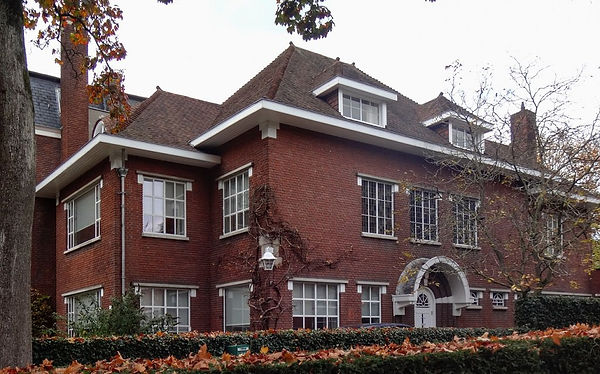
There was already a large house on this site before 1900, but without a front garden. In 1938, Theo had a new house built here by architect Frans Hovers. For Theo, a garage at his house is of course a first requirement. By placing the house across the plot, he creates the necessary space for this. Hovers has succeeded in turning it into a distinguished house, using a warm brick color in which the white-painted multi-pane steel windows stand out nicely. At the end of the roofs, we see imposing chimneys at the front and rear.